


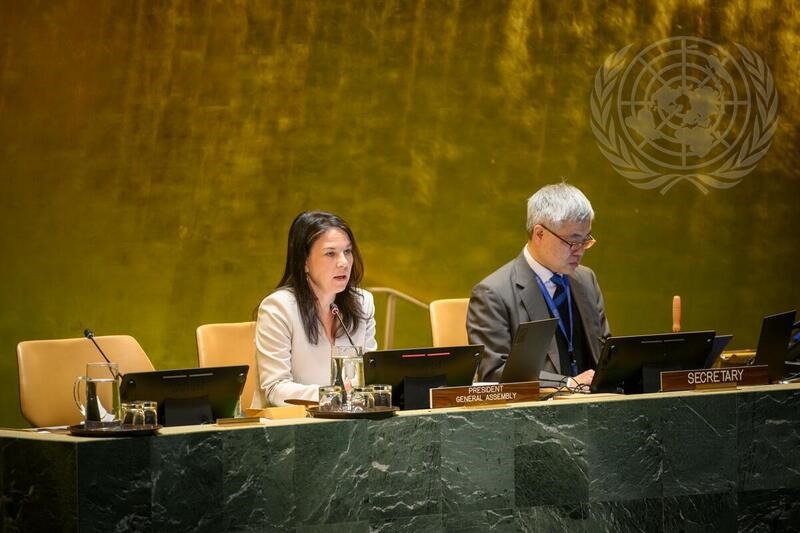

NEWYORK: President of the General Assembly Ms. Annalena Baerbock said global internet access stands at 67 percent while in developing countries it is just 35 percent.
Addressing at the high-level meeting on the overall review of the implementation of the outcomes of the World Summit Information Society (WSIS+20), Annalena Baerbock said that the digital divide remains a digital canyon for too many.
“Undoubtedly, we have made progress over the past two decades. But deep inequalities remain,” she said.
Ms. Annalena said that this gap is not only morally unacceptable, it also poses practical barriers to lifting societies out of poverty, expanding opportunity, improving health outcomes, and unlocking humanity’s full potential.
She also pointed out that the digital gender divide continues to deny women and girls equal access to opportunity.
“Globally, men are still 21 percent more likely to have internet access than women.”
She said that closing this gap is not only a question of fairness but it is a plain economic sense.
She said that closing the gender digital divide could add over 100 trillion US dollars to the global economy by 2050—more than the combined GDP of the United States and China today.
“When women are online, societies grow stronger, more prosperous, and more resilient,” she said.
Ms. Baerbock said access alone is not enough and emphasized that we must ensure responsible governance of emerging technologies.
She was of the view that artificial intelligence has immense potential to accelerate development gains, and these should be pursued.
She said that we cannot ignore the red flags or risks—particularly when innovation outpaces regulation, oversight, and ethical safeguards—and as a result, amplifies gender bias online in an incredible dimension.
UNGA President said that as many as 96 percent, so almost all, of deepfake videos online are of women engaging in sexual acts adding that this is no coincidence, it is systematic.
She warned that without inclusive governance frameworks that keep the pace of technological advancements, such harms will only intensify.
She said that we must therefore harness AI’s potential, minimise its risks, and equalise its reach.
She said that two decades after the World Summit on the Information Society, our work is far from finished. She said that delivering meaningful, safe, and inclusive connectivity for all remains a defining challenge of our time.
She said that as we conclude the 20-year WSIS review process, we also open a new chapter of cooperation.
She said that this process has recognized that governments alone cannot deliver the digital future we need.
“Instead, we have seen how partnership with the private sector and a strong civil society has created a truly participatory process, more than we have seen before. Making our work, making our outcomes better, she said adding that this approach has strengthened trust, broadened ownership, and delivered an outcome that is both inclusive and transparent.
She said that in today’s world, connectivity is not just essential in big cities at work in our daily office, it is also a lifeline for those in the most remote places.
She encouraged member states to apply this model across other UN processes and high-level meetings—to build a United Nations that is fit for purpose and fit for the realities of the digital age.
