


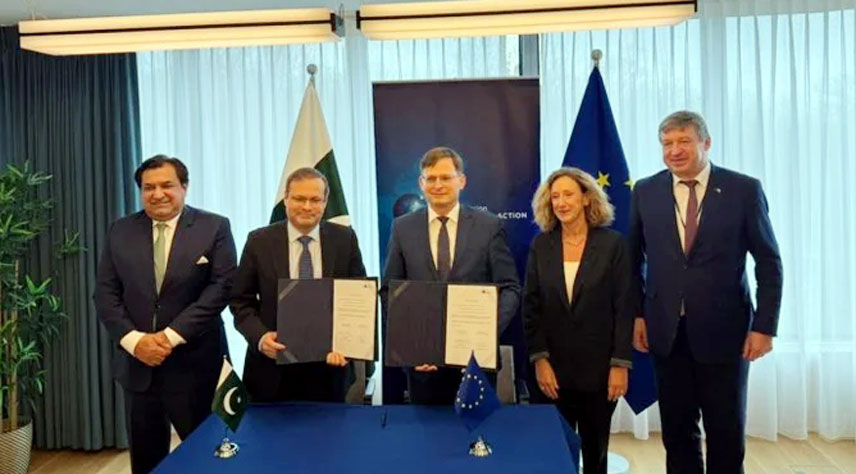

BRUSSELS: Pakistan and European Union have agreed to enhance cooperation in diverse fields including governance, trade, migration, climate, energy and science and technology.
The understanding reached during 15th European Union (EU) – Pakistan Joint Commission meetings held in Brussels.
The two sides stressed the importance of maintaining close cooperation on Human Rights.
Both sides reviewed Pakistan’s progress on the implementation of the 27 international conventions as required under the GSP+ framework.
The EU is Pakistan’s second-largest trading partner, with Pakistan being the main beneficiary of the Generalised Scheme of Preferences Plus (GSP+) arrangement.
Both sides discussed follow-up of the GSP+ Monitoring Mission including the upcoming GSP report and re-application to the GSP+ scheme under the new Regulation.
The two sides highlighted the need to improve the overall business environment and expressed their commitment to advance this work, including at the upcoming EU-Pakistan Business Forum to be held in Islamabad in April next year.
The EU and Pakistan agreed on the continued relevance of key priority areas under the ongoing Multiannual Indicative Programme. In this context, Pakistan welcomed the EU’s continuous support for climate change resilience.
The EU presented the outline of the projects for the period 2025-27 and updated on its policy framework and Global Gateway strategy.
The two sides also discussed regional programmes and recognised the importance of strengthening regional collaboration in areas of common interest.
Reaffirming their commitment to the EU-Pakistan Strategic Engagement Plan of 2019, the two sides assessed progress achieved over the past six years.
The Joint Commission reviewed progress under the EU-Pakistan Comprehensive Dialogue on Migration and Mobility. The EU welcomed Pakistan’s concrete steps to improve cooperation on migration-related issues in particular on countering irregular migration and migrant smuggling.
The two sides also examined the potential for expanding co-operation in the area of climate change and environment, education, culture, science, technology, connectivity and digitalisation. They agreed to explore research collaborations under the Horizon Europe Programme.
The EU and Pakistan recognised the significance of regional collaboration on security challenges, particularly in the areas of counterterrorism and counter-narcotics.
Both sides affirmed their support to the implementation of the Comprehensive Plan to end the Gaza Conflict. They underscored their support for concrete steps towards the two-state solution in accordance with the relevant UN resolutions.
Both sides stressed the importance of resolving conflicts peacefully and in full conformity with international law and the principles of the UN Charter.
It was agreed to hold the next session of the EU-Pakistan Joint Commission in Islamabad next year.
