


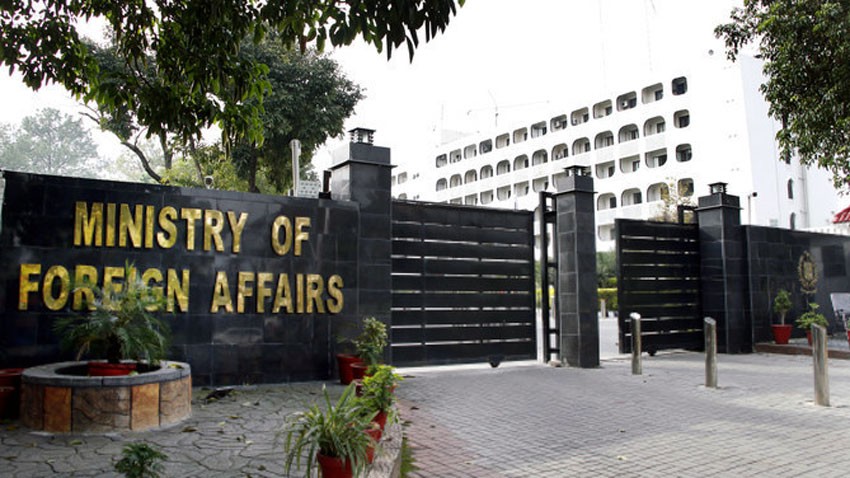

ISLAMABAD: Pakistan has categorically rejected the undiplomatic and irresponsible remarks made by India at the UN.
This was stated by Foreign Office Spokesperson Sajjad Haider Khan, while replying to a question during his weekly media briefing in Islamabad.
He said such baseless accusations merit no attention and are instantly and effectively rebutted by the representative of Pakistan during the same meeting. Such diatribe, so typical of India, can only be rubbished.
The Spokesperson said these remarks constitute an unacceptable interference in Pakistan’s internal affairs and are antithetical to the Charter of the United Nations. Instead of addressing Pakistan’s legitimate concerns with respect to India’s hydro-terrorism, India has resorted to unsubstantiated insinuations about Pakistan’s institutions and leadership.
Sajjad Haider Khan said India’s hostility towards Pakistan’s development of its mineral resources is equally evident in its persistent efforts to undermine Pakistan’s stability.
He said Pakistan has repeatedly raised concerns, supported by evidence, regarding India’s sponsorship and support of terrorist activities in Balochistan and Khyber Pakhtunkhwa, aimed at disrupting development and depriving local populations of the benefits of their natural resources.
The Spokesperson said India’s continuing descent into a Hindutva-inspired extremism-fascist polity, led by a religious fundamentalist regime is well known.
He said Indian accusations and distortion of facts are a futile attempt to hide its international isolation, and only aimed at distracting attention from India’s domestic situation and its weaponization of shared resources, as evident from its illegal and unilateral action to hold the Indus Waters Treaty in “abeyance”.
Sajjad Haider Khan further said on the Indus Waters Treaty, the facts speak for themselves. He added that on 31 August 2026, the Court of Arbitration, constituted under the Treaty, unanimously ruled that the Treaty remains binding and fully in force, and there was no legal basis for its unilateral suspension or termination. India’s refusal to accept this ruling raises serious questions about its commitment to treaty obligations and international law.
The Spokesperson said instead of misusing the platform of the UN for peddling lies, India will be well advised to implement its obligations under the UN Security Council resolutions on Jammu and Kashmir, where Indian occupation forces continue to perpetrate gross violations of human rights for decades.
Sajjad Haider Khan said a State that is a serial violator of UN Charter, Security Council resolutions, sovereignty of neighbouring States, and binding treaty obligations; that patronizes systematic discrimination against its Muslim, Sikh, Christian, and Dalit minorities; engages in disinformation and terrorism as instruments of state policy, and remains in forcible occupation of a territory whose people it denies the internationally guaranteed right to self-determination, has no standing whatsoever. Instead of pointing fingers, India should introspect and change its behaviour.
Replying to another question, Sajjad Haider Khan said nearly twenty seven hundred Sikh Yatris from India are expected to participate in the birthday celebrations of Baba Guru Nanak.
Answering yet another question, the Spokesperson said Afghanistan was not invited to join the ECO meeting in Islamabad as Pakistan has not recognized the incumbent regime.
He said Afghanistan’s membership of the ECO Forum Secretariat remains suspended. Moreover, as per ECO procedures, participation in the ministerial level meetings is subject to the host country’s discretion also.
The Foreign Office Spokesperson made it clear that Pakistan attaches great importance to strong regional cooperation, connectivity and economic integration. He said Pakistan also wants to see Afghanistan, a peaceful, prosperous and stable country, fully integrated within the ECO framework and at peace with itself as well as with all its neighbours.
He further said that at the same time, Pakistan believes that meaningful progress requires Afghan authorities to address the legitimate security concerns of neighboring countries, particularly the threat of terrorism emanating from Afghan soil, in the interest of sustained regional peace, stability and development.
